

Malaysia eyes cloud seeding as drought drags on
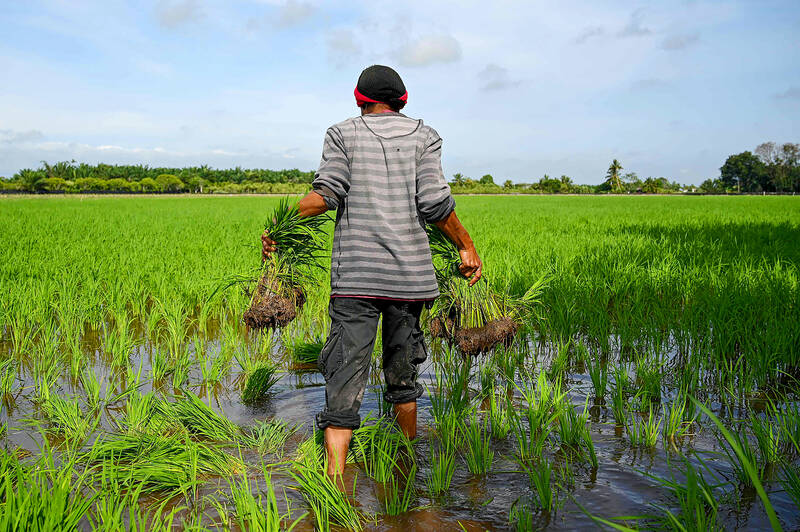
The nation’s nationwide safety may very well be threatened if it doesn’t produce sufficient rice, the agricultural minister stated
By Aneeta Bhole and Ebrahim Harris / AFP, KUALA LUMPUR
Malaysia is trying to make use of cloud seeding to deliver much-needed rain to the nation’s “rice bowl” north, the place a drought has delayed planting of the staple crop and raised provide fears.
“This year… has been affected by prolonged dry weather, low rainfall and reduced dam water levels,” Malaysian Minister of Agriculture and Food Security Mohamad Sabu stated.
The situations imply farmers have missed two of the three regular planting phases for “wet direct seeding” of rice, a method that requires fields to be flooded. Dry direct seeding is an alternate that’s viable till June.
Photo: AFP
However, farmers say the approach gives decrease yields and that climate situations have rendered it inconceivable in some fields anyway.
While greater than 50 % of the area’s rice fields have been ready, only a fraction have been planted as farmers look ahead to the rain.
Planting has “not been canceled,” Mohamad insisted, however “temporary adjustments and mitigation measures are being implemented.”
In Kedah’s Muda Agricultural Development Authority areas, the primary dam reservoir for the area is at simply eight %, in response to native stories.
HIGH COSTS
Farmer Abdul Rashid Yob, who has a 3 hectare paddy within the area, stated the drought’s affect was being compounded by rising gasoline prices linked to the battle in Iran.
“Even where water is available, many cannot afford to proceed due to high costs.”
Rice is a staple crop in Malaysia, which consumes about 2.5 million tonnes a 12 months, about half of which is produced domestically.
Most of that comes from northern peninsular Malaysia, with Kedah the largest producer.
The area is “strategically important to Malaysia’s food security”, Mohamad stated.
So with farmers dealing with dry brown fields that needs to be lush, flooded paddies, Malaysian Prime Minister Anwar Ibrahim this week introduced cloud-seeding operations to set off rain.
The course of includes spraying particles such as silver iodide and salt into clouds from plane to supply rainfall and is used to have an effect on climate patterns and even tamp down air air pollution.
But success relies upon on atmospheric situations — with out clouds, seeding doesn’t work. Reports counsel officers hope to start seeding quickly, however no date has been publicly set.
The authorities has introduced applications to offset gasoline prices, together with boosts to assist applications.
STRUGGLING WITH CONDITIONS
Fitri Amit, a small-scale rice farmer within the Perak area to the south, was skeptical of the measures, which he stated have been usually delayed, arriving solely as soon as farmers’ “capital has already been drained.”
“Farmers prefer that support be given by increasing the paddy price,” he stated, referring to the sale worth of cultivated rice.
“If the paddy price is guaranteed, once they sell, they get the money,” he stated.
Although he’s south of Kedah’s dire climate, he has additionally been scuffling with dry situations.
“Irrigation was stopped because the reservoir levels were low,” he stated.
While Malaysian rice farmers have struggled with drought or erratic rainfall up to now, “this year’s challenges are more significant,” stated Mohamad, citing “prolonged hot weather, lower-than-usual rainfall and declining water reserves in several irrigation dams.”
The disaster comes with Asia bracing for a attainable return of the El Nino climate phenomenon, which brings worldwide modifications in winds, air stress and rainfall.
Forecasters say it may develop as quickly as May to July, and preliminary observations counsel it may very well be notably sturdy.
Asia is commonly closely affected by El Nino programs, which deliver heatwaves and droughts to a part of the area and heavy rains elsewhere.