


Why the president of the government of Spain, Pedro Sánchez, is fighting an X battle with billionaire Elon Musk
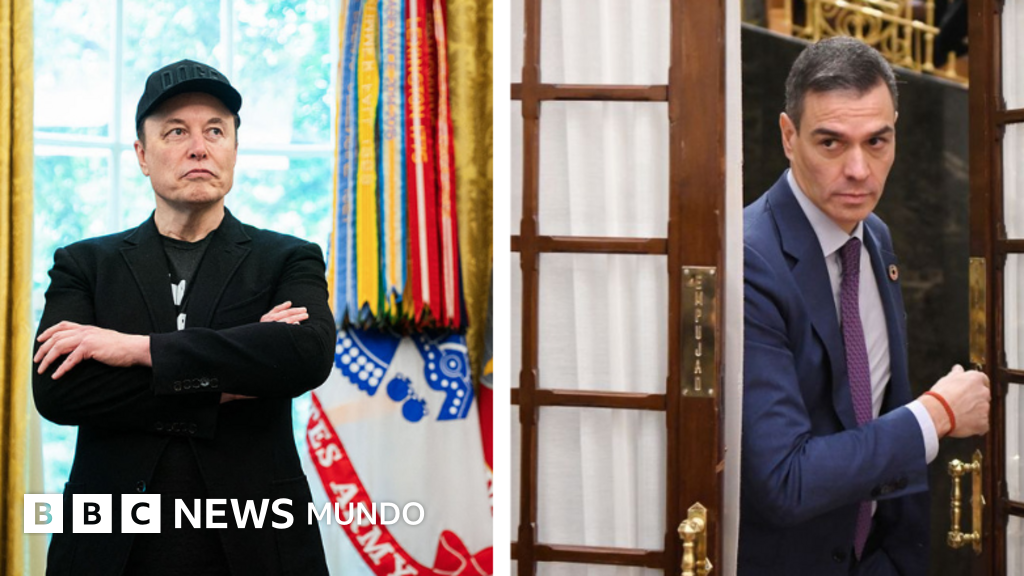
Image source, getty
Reading time: 6 min
Elon Musk landed in Spanish politics this week with an unexpected succession of disqualifications towards President Pedro Sánchez.
The American magnate called the Spanish president a “tyrant”, a “traitor to the Spanish people” and a “fascist” in several messages on his social network X.
He also referred to the socialist politician as “dirty Sánchez” (dirty Sanchez) and placed next to his name the emoticon of an excrement with eyes.
It was Musk’s response to Sánchez’s announcement that his country will prohibit access to social networks for those under 16 years of age and will promote legal changes so that the directors of the companies that own them have to respond criminally for the illicit content disseminated on them.
Musk’s comments were joined this Wednesday by Pvel Durov, founder of the Telegram messaging system, who accused Sánchez on his platform of promoting “dangerous regulations” that could lead to the establishment of a “surveillance state” in Spain.
Sánchez responded to this last comment in X.
“Let the techno-oligarchs bark, Sancho, it is a sign that we are riding,” the president wrote, referring to a Spanish expression that in popular culture is attributed to one of Don Quixote of La Mancha’s advice to his squire Sancho Panza in the historical 17th century novel.
What Pedro Sánchez announced
The Spanish president announced at an international event held this week in Dubai that his country will prohibit access to social networks by minors under 16 years of age, who will be required to implement effective systems to verify the age of users.
Sánchez said that “social networks have become a failed state in which laws are ignored and crimes are tolerated” and promised that his government will protect minors “from the digital Wild West.”
He also assured that, among other measures, legal reforms will be promoted so that platform managers are held legally accountable for violations committed on them. “This means that CEOs of technology platforms will face criminal liability if they do not remove hateful or illegal content.”
“Social networks, their companies, are richer and more powerful than many countries, including mine. But their power and influence should not scare us because our determination is greater,” Sánchez proclaimed.

Image source, Getty Images
Sánchez’s announcements provoked a reaction from Musk, who published a succession of messages on X responding to the video of Sánchez’s intervention in Dubai.
“Sucio Sánchez is a tyrant and a traitor to the people of Spain,” he stated in the first, next to which he placed the fecal emoticon.
Less than two hours later he returned to the attack: “Sánchez is the true totalitarian fascist.”
On Wednesday he shared messages from other users on his network criticizing Sánchez on X. One of them said that “Spain is on the path to North Korean censorship” and that “Pedro Sánchez’s government is promoting dangerous new regulations that threaten your freedoms on the internet.”
The controversy over the regularization of immigrants
A few days before, Musk and Sánchez had had an exchange on the networks regarding the decision recently adopted by the Spanish government to regularize hundreds of thousands of irregular immigrants present in the country.

Image source, Carlos Castro/Getty
The Spanish Minister of Inclusion, Social Security and Migration, Elma Saiz, defended the extraordinary regularization of immigrants as “necessary to respond to the reality that exists on our streets” and said that it seeks to “recognize, dignify and give guarantees, opportunities and rights to people who are already in our country.”
The open-door immigration policy promoted by the Sánchez government has attracted attention on the international scene at a time when the United States and several European countries apply increasingly restrictive measures.
Musk was one of those who criticized the regularization announced by the Sánchez government. The millionaire shared with his 233 million followers on X a video by Malaysian political commentator Ian Miles Cheong in which he accuses Sánchez of approving the regularization to “defeat the extreme right.”
“The logic is simple: legalize half a million people, accelerate their access to citizenship,” said Chong’s video, which Musk shared adding: “Wow.”
Sánchez responded to this latest message from Musk with another in which he stated: “Mars can wait. Humanity, no.”

Image source, Eduardo Parra/Getty
The main opposition parties in Spain have come out against the Sánchez government’s latest regularization, which the far-right Vox has described as “the murder of Spain” and an “invasion.”
The measure has also been criticized because the government has approved it without going through Parliament, where it did not have the necessary support.
Sánchez’s executive and the social organizations that support the measure maintain that it will serve to give rights to people who already contribute to the good economic moment that the country is going through and will allow for an increase in formal employment and, consequently, tax collection.
Europe against the networks
The clash between the Spanish president and Musk comes at a time when a growing number of European countries are beginning to take measures to curb abuse on social networks and protect minors from excessive or harmful exposure to them.
In the wake of Australia, the first country in the world to prohibit access to social networks for those under 16 years of age, France, the United Kingdom and others are debating laws along the same lines.
The same day that Musk criticized Sánchez on
X had to disable the feature of its Grok tool that allowed users to obtain nude images generated by Artificial Intelligence from photographs of real people after days of international controversy and Musk’s initial refusal to do so.
And the Digital Services Law approved by the European Union has also increased the requirements and demands on the companies that own social networks, mainly in the hands of American technology giants such as X and Meta.
Donald Trump’s government has criticized the measures approved in Europe as an attack on freedom of expression, a criticism that Musk has also repeated and that has contributed to the growing distance between the United States and its European allies.
Musk has publicly supported parties of the European far-right, with which forces such as Sánchez’s Spanish Socialist Workers Party and the left-wing formations that make up his government coalition compete.
Sánchez has been one of the European rulers critical of the networks and their millionaire owners, whom he often refers to as “the technocasta.”
“Europe must stand up and rebel against this threat to democracy,” he said in January last year.

Subscribe here to our new newsletter to receive a selection of our best content of the week every Friday.
And remember that you can receive notifications in our app. Download the latest version and activate them.