Photos: See the dramatically transformed Reynisfjara Black Beach
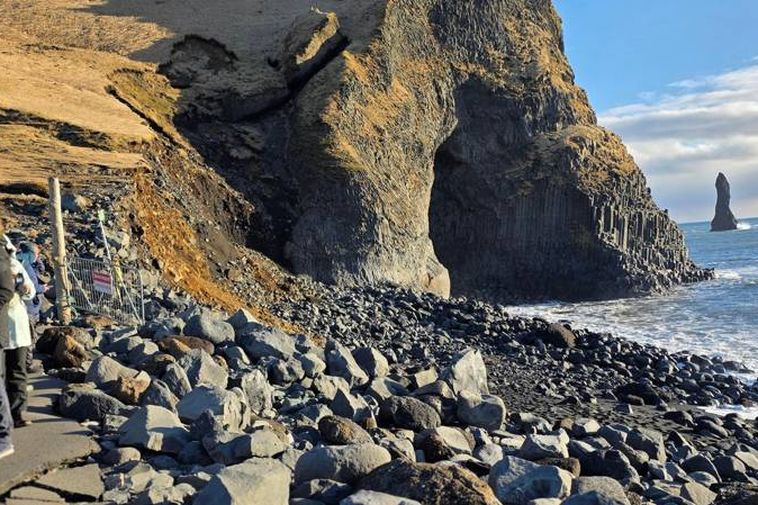
Where a sandy beach once extended outward, there is now deep water and a shoreline strewn with large boulders. The sea now flows into the cave that was previously accessible on foot. Coastal erosion now reaches almost all the way up to the warning sign on the ridge.
mbl.is/Jónas Einarsson
“This is incredible to witness. The forces of nature have completely reshaped the beach, so the place is now entirely different from what it was,” says tour guide Snorri Steinn Sigurðsson.
The appearance and surroundings of Reynisfjara Black Beach in Mýrdalur have changed dramatically following developments over the past few days.
The sea now reaches areas that were previously walkable
Powerful ocean currents have carved deep into the sandy beach, in places by dozens of meters. Previously, it was possible to walk right up to the basalt columns and the cave there, but now the sea reaches those areas. Where there was once exposed shoreline, there is now a high erosion bank, and below it in the sand are large, heavy stones being violently tossed back and forth by the immense force of the surf.
Reynisfjara Black Beach is a popular tourist destination, where heavy Atlantic waves crash ashore in a spectacular setting. Hundreds of thousands of people visit the site each year, and it is a regular stop on organized tours. However, it is a dangerous place, as evidenced by several fatal accidents in which powerful waves have swept people away after they ventured too close to the water’s edge and were caught by the surf, dragged out, and drowned.
No reason to wait for an accident
“I have seen changes in Iceland’s natural landscape over the ten years I’ve worked as a guide, but things have never happened as fast as they are now,” says Sigurðsson, who works for Iceland Travel. Speaking about the situation at Reynisfjara, where a high erosion bank has formed, he says tourists are tempted to climb down it and walk all the way to the shoreline.
“At the moment, the weather here is calm and conditions seem harmless. But if the waves grow higher and tourists are already down at the waterline, they could be in serious trouble if waves emerge ashore, because it would be impossible to scramble back up the bank that you have formed. I believe this means surveillance needs to be increased at the beach, at least while the situation becomes clearer. There is no reason to wait for an accident before stepping up preparedness.”
Rapid changes
“The changes have been rapid. The beach is always evolving, but I have never seen anything like this happen. It’s quite a sight,” says Guðni Einarsson of Þórisholt in Mýrdalur, one of the landowners in the area.
In recent weeks—indeed, for several weeks now—persistent strong easterly winds have affected the country, which helps explain the developments at Reynisfjara Black Beach. Enormous amounts of sand have been washed away recently and carried westward toward Dyrhólaey. This kind of process comes and goes, except that everything now is happening on a much larger scale than has been seen before.
“To the north of the country there has been a broad high-pressure system, and deep low-pressure systems to the south. The intersection of all this is the south coast, and the result can be seen at Reynisfjara Black Beach. I don’t think it will lose any of its appeal as a tourist destination despite this,” says Einarsson. “Most of the tourists seen here are visiting the area for the first time, and for them the place is likely just as spectacular as it has always been.”